
A mission to make Voice AI more accessible to developers
Inworld, a company initially focused on enhancing the gaming experience through AI, soon realized its potential stretched beyond the gaming industry. The team saw a broader opportunity to give developers high-quality tools to build richer, more natural user experiences, starting with voice. This move wasn't just a pivot, it was a broadening ambition to empower developers to focus on user experiences rather than the complexities of AI. "The gaming industry faces numerous challenges, notably the cost of AI technologies like speech synthesis," explains Igor Poletaev, Chief Science Officer at Inworld. Traditionally, high-quality voice AI was both expensive and resource-intensive. But Inworld’s aspiration was clear: provide state-of-the-art, cost-efficient voice AI capabilities without compromising quality.
Cost, speed, and complexity
For Inworld, the obstacles were considerable. Training a text-to-speech model is computationally intensive, and for smaller teams, that makes iteration expensive. Inworld knew that long training times and custom tooling could slow them down before they even got to the product layer. "The challenge is building high-quality voice AI at scale," said Poletaev. “You’re dealing with large models, multi-node training, high-performance computing (HPC) infrastructure, and real-time performance requirements. Every slowdown adds up.”
They needed to move faster, without the costs of infrastructure or engineering rising.
Focused on models, not infrastructure
Having fostered a deep-rooted expertise in machine learning, many of Inworld’s team members carried experience from giants like Google. The team has experience building ML systems at scale. But this time, they didn’t want to sink time into engineering infrastructure. A quick search led them to PyTorch Lightning, Lightning’s open-source framework promised to handle the messy, repetitive parts of training, so the engineers could focus on their models. "It abstracted away the messy details," reflects Poletaev. "By adopting PyTorch Lightning, we could bypass substantial engineering overhead."
Inworld used Lightning to build and train Inworld TTS, a fast, efficient text-to-speech system. The team distributed training across multiple nodes without needing to write custom tooling, cutting down engineering overhead significantly.
Two engineering months saved
By skipping the buildout of custom infrastructure and accelerating training, Inworld estimates they cut months off their development timeline. That saved engineering costs, and let them launch faster. “Lightning helped us bring our voice model to market much earlier than planned,” said Poletaev. “That meant more feedback, more iteration, and more value for users.”
The advanced PyTorch Lightning framework allowed them to distribute training across various nodes, ensuring that the heavy lifting of neural network training was managed efficiently. This capability was crucial for their project, Inworld TTS.
The choice to leverage PyTorch Lightning resulted in substantial savings, quantifiably reducing the development timeline by roughly two months. This advanced time-to-market and equated to significant financial savings in engineering salaries. "We saved around two months of engineering time, allowing us to allocate resources more efficiently and bring our innovations to users faster," Igor Poletaev estimates.


Opening the limits of high-quality AI
Inworld’s journey hints at a larger shift. AI development isn’t just about more power or better algorithms. It’s about making that power accessible so more people can build, experiment, and create. For them, accessibility is the foundation of meaningful progress. “Voice AI shouldn’t be limited to big players,” said Poletaev. “If we can make it cheaper and faster to build, more people can create better experiences.”
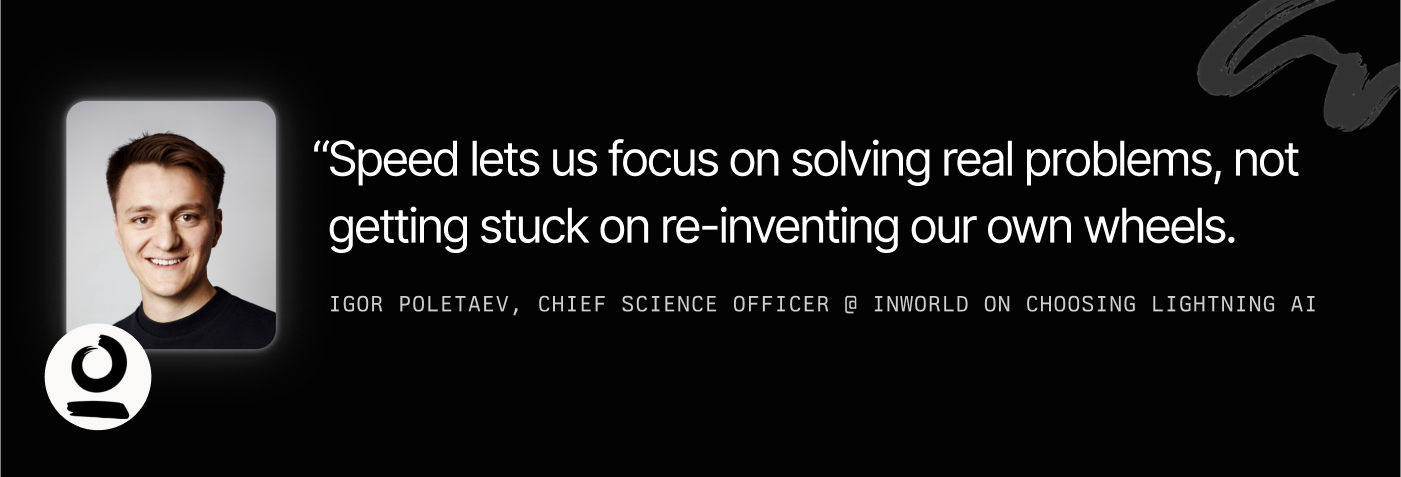
Inworld believes that when barriers like infrastructure, training time, and cost are removed, people can build more human-centered tools. Shipping their TTS model ahead of schedule allowed Inworld to provide developers with an affordable voice model sooner, accelerating the creation of new voice AI applications. “That kind of accessibility depends on moving quickly,” Poletaev added. “Speed lets us focus on solving real problems, not getting stuck on re-inventing our own wheels. Tools like PyTorch Lightning help make that possible.”
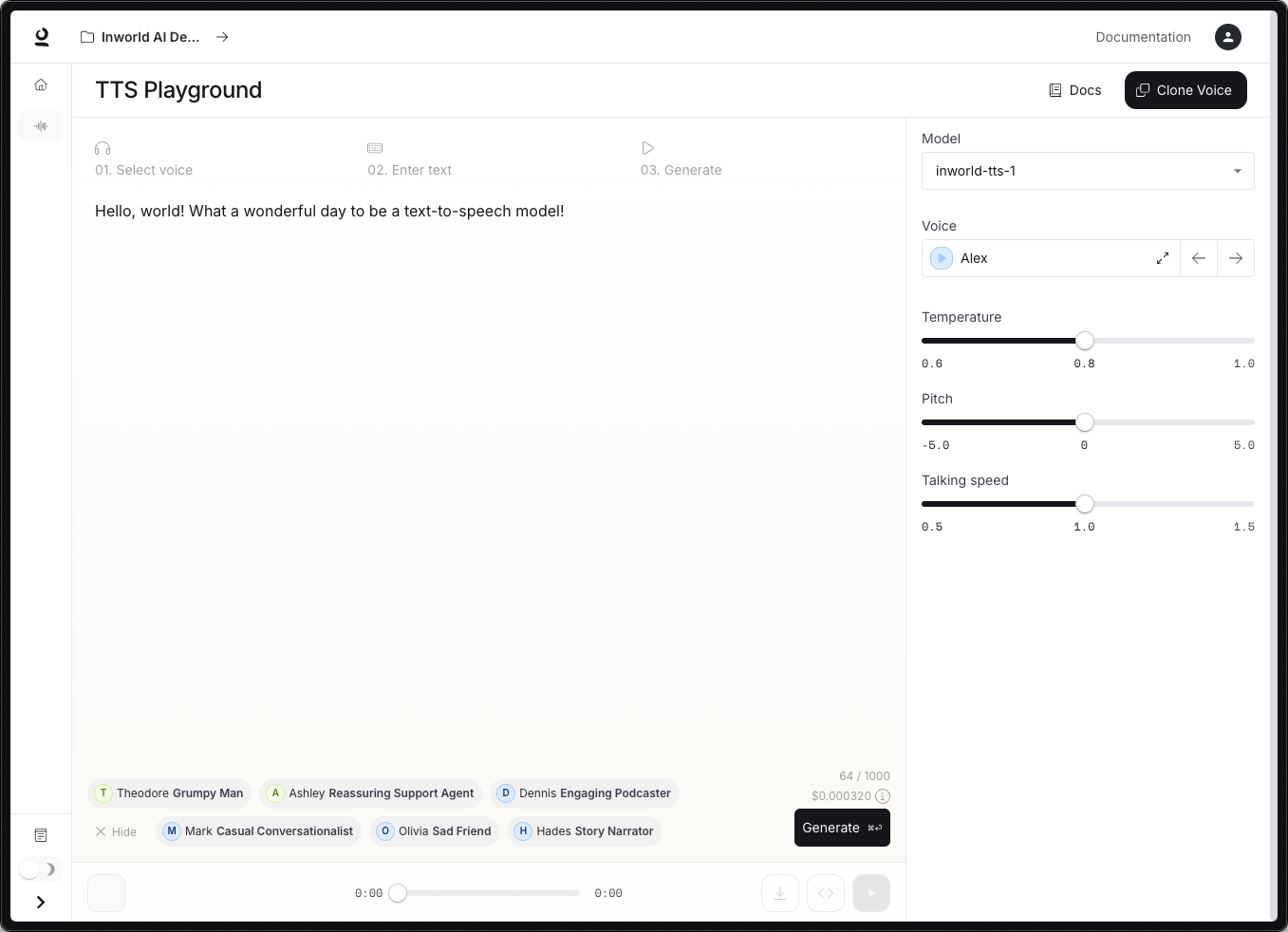
You can try out Inworld’s new TTS model at their TTS Playground, and read more about the development of the model here.
Read more case studies and blogs:
• Infineon Builds a Language Model Small Enough to Run on a Microcontroller in 4 Months
• Slalom Accelerates Model Development and Cuts Setup Time Using Lightning AI
• View all