
Shadow AI: What It Is, Why It Happens, and How to Stop It
If you run AI infrastructure at a large organization, shadow AI is already happening on your watch. Your teams aren’t reckless, your slow infrastructure is creating bottlenecks they know how to work around with methods and tools that aren’t approved.
This article defines shadow AI and explains why it appears in well-funded organizations. It outlines the specific risks it creates. It also shows how Lightning AI reduces risk through platform controls, not policy.
What Is Shadow AI
Shadow AI is any AI infrastructure, compute, or tool that runs outside IT or platform visibility and control. It can look like this:
- A researcher can’t get GPU access through the ticket queue so they spin up a personal AWS account and run training jobs there.
- A team builds a workflow around a consumer GPU cloud subscription paid on a corporate credit card.
- Researchers form a slack channel to share workarounds because approved tools don’t support their real workflows.
- A model trains on proprietary data in an environment the security team never audited.
Shadow AI is the default response of a technically capable research team to an infrastructure bottleneck. If your researchers are good at their jobs, they will find a way to do those jobs with or without you.
The question is whether you can see what they are doing.
Why Shadow AI Happens
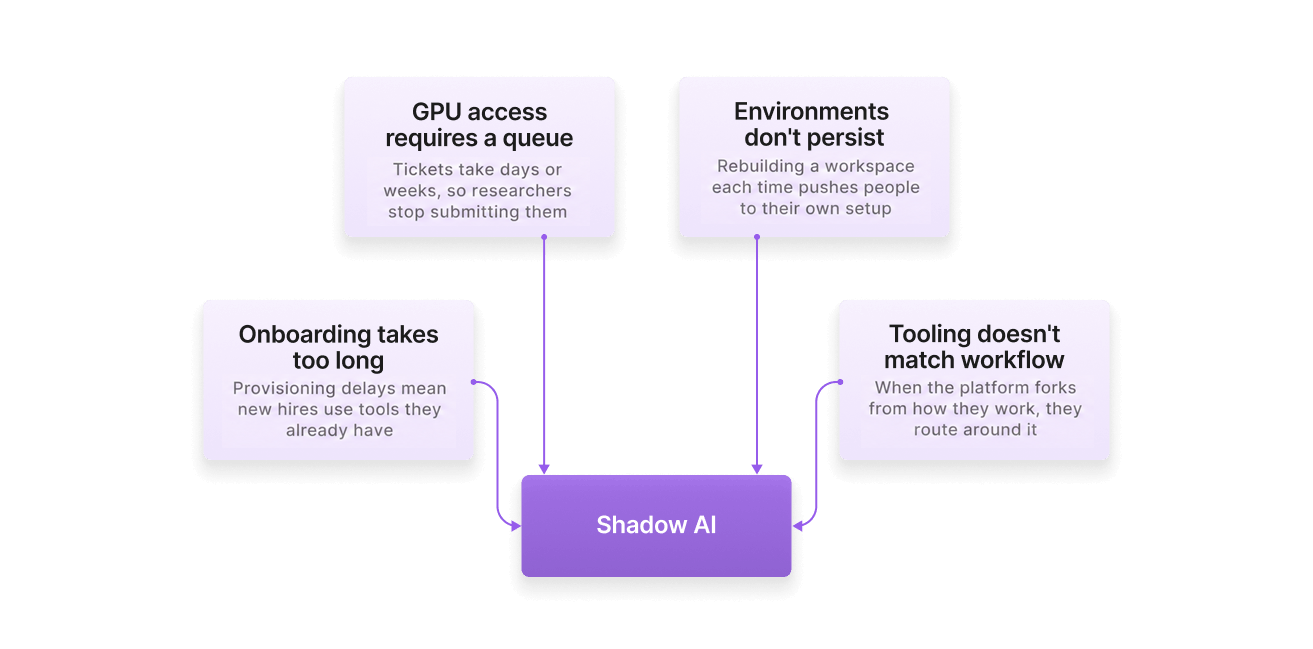
Shadow AI has one root cause: the workaround is faster than the approved path. There are four infrastructure failures that consistently produce shadow AI:
- GPU access requires a queue. When researchers submit tickets and wait days or weeks for compute, they stop submitting tickets, then find it themselves.
- Environments do not persist. When a researcher must rebuild their workspace from scratch, they often abandon the shared environment. They then build their own instead.
- Onboarding takes too long. When you onboard a researcher but provisioning delays prevent them from working, they use the tools they already know and can access. These are rarely approved corporate tools.
- The tools do not match how researchers work. Academic and research environments teach workflows. When the corporate platform forks (different frameworks, different interfaces, different abstractions) researchers route around it.
These four core paths to shadow AI all stem from solvable infrastructure problems.
Why Shadow AI Isn’t All Bad (At First)
In early stages, shadow AI is how motivated team members find what works and the organization formalizes it later. This sequence makes sense at startup stages when teams are small, stakes are low, deadlines are tight, and the data is not sensitive.
On the converse, shadow AI reveals a truth: your team is resourceful and motivated. Not waiting for permission is accelerating the building. The problem emerges when this pattern scales.
When Shadow AI Becomes a Serious Problem
As orgs grow, shadow AI compounds fast. Workarounds that seemed harmless for a team of ten become a serious liability at 50. Gartner identifies shadow AI cost visibility as a top operational concern for enterprise research leaders. Their recommended response is enterprise-wide policy and regular audits. That addresses the behavior, not the cause. Researchers use shadow environments because the approved path is too slow. A faster platform reduces the need for them to resort to shadow AI tactics to get the job done.
Here’s why that distinction matters:
- Costs become fragmented and invisible. Personal cloud accounts, GPU subscriptions, and ad-hoc compute purchases skip the infrastructure budget entirely, surfacing later as miscategorized expenses. This makes accurate AI ROI calculations nearly impossible.
- Data governance breaks down. Training jobs run in unapproved environments erase visibility into what data touches which model. This produces a major audit risk in regulated industries like life sciences, healthcare, and capital markets.
- Security exposure multiplies. Every personal account storing credentials, model weights, or proprietary data becomes an additional, unmonitored attack surface.
- Siloed knowledge. Critical institutional knowledge lives in individual workarounds. When a researcher leaves, the model behind last quarter's key decisions often goes too. It may be stuck in a personal S3 bucket that no one can access.
- Collaboration collapses. Isolated environments mean researchers can't share workspaces or build on each other's work, fragmenting the team into disconnected individuals.
Platform leaders are accountable for infrastructure reliability, security, and AI ROI. Shadow AI leaves them responsible for outcomes in environments they can't see, don't control, and never approved. As AI investment scales, that gap becomes untenable.
The Wrong Solution: Policy
The instinct when shadow AI surfaces is to write a policy. Approve a list of tools. Require researchers to use only sanctioned environments. Enforce through IT controls.
This does not work.
Researchers who could not get GPU access through the ticket queue will not suddenly get their experiments done through a stricter ticket queue. They will find a new workaround that is harder to see. The shadow AI goes deeper underground. The visibility problem gets worse, not better.
Policy addresses the symptom. Speed addresses the cause.
The Right Solution: Make the Approved Path Faster Than the Workaround
Shadow AI does not require enforcement to disappear. It requires a platform that moves at research speed.
When researchers can get GPU access in minutes instead of weeks, they stop spinning up personal cloud accounts. When environments persist between sessions, researchers stop maintaining their own. When onboarding takes hours instead of weeks, new researchers use the shared platform from day one. When the tooling matches how researchers actually work, they stop building workarounds.
- The platform leader gets what they need: visibility, cost control, compliance, and one system of record for AI development.
- The research leader gets what they need: faster production and more experiments.
- The researcher gets what they need: on-demand GPU access they can use in persistent environments.
This is the only solution that eliminates shadow AI without eliminating research velocity.
How Lightning AI Overcomes Shadow AI
Lightning AI is an enterprise AI platform built for research teams that need speed and compute without sacrificing control. It addresses every driver of shadow AI directly:
- On-demand GPU access. Lightning AI owns more than 36,000 NVIDIA GPUs so researchers can build on state of the art hardware in minutes without a procurement cycle.
- Persistent environments. Workspaces persist between sessions. Researchers configure their environment once, and dependencies, datasets, and settings remain ready at every login. This recovers the 10% of researcher time lost to manual setup.
- Collaborative by default. Teams share workspaces, reference each other's experiments, and build on shared work in one environment. The platform eliminates the isolation that drives shadow AI.
- Full model lifecycle in one platform. Lightning AI covers the workflow from experiment to production. Fewer tools means fewer integration points and fewer places for shadow AI to take root.
- Real-time visibility and cost control. Platform teams see resource usage and costs across the research organization in real time. No expense report surprises, no unaudited environments.
- Compliance-ready infrastructure. Backed by our owned hardware, Lightning AI meets the data residency, security, and audit requirements that consumer GPU clouds and personal accounts cannot.
Researchers who work on Lightning AI run more experiments and hit production targets. Platform leaders eliminate shadow platforms while proving ROI on AI investment.
Start Your Proof-of-Value Trial on Lightning AI Today
The fastest way to eliminate shadow AI in your organization is to give your research team a better option and let them choose.
Lightning AI runs a structured proof-of-value trial with enterprise teams. At the end, you know exactly what your cost-per-training-run looks like, how fast your researchers can get GPU access, and whether Lightning AI replaces the tools they are currently working around.
Start your proof-of-value trial
Frequently Asked Questions
What is the difference between shadow IT and shadow AI?
Shadow IT covers any technology used without IT approval: software, hardware, cloud services. Shadow AI is a subset specific to AI development: the compute, tooling, and environments researchers use to build, train, and deploy models outside platform team visibility. Shadow AI carries unique risks due to the data sensitivity in model training and the regulatory requirements that apply to AI outputs in many industries.
Is shadow AI illegal?
Shadow AI is not inherently illegal, but it creates conditions for illegal activity or regulatory non-compliance. Training a model on proprietary or personally identifiable data in an unapproved environment can violate GDPR, HIPAA, or other data protection regulations depending on industry and jurisdiction. Legal risk scales with the sensitivity of the data involved.
How do I know if my organization has a shadow AI problem?
If your researchers are technically capable and motivated, and approved GPU access takes more than 48 hours, you have a shadow AI problem. Watch for these signals: expense reports with unfamiliar cloud vendor charges, researchers who skip the approved GPU request system, production models with no identifiable training environment, and research workflows no one can reproduce because they ran on uncontrolled infrastructure.
Can shadow AI be eliminated without restricting researchers?
Yes. The goal is not restriction. It is building a platform researchers prefer over the workaround. When the approved path beats the shadow environment on speed, ease, and collaboration, researchers choose it. Speed is the right frame, not restriction.