
Enterprise AI is moving from experimentation to production, and that shift changes what infrastructure and platforms need to deliver.
Teams increasingly need secure, high‑performance systems that support the entire AI lifecycle, from data preparation and model training to deployment and inference.
Cisco AI Pods are built for this stage of enterprise AI.
Lightning provides the software layer that allows enterprises to operate the full AI lifecycle on top of Cisco AI Pods, securely and at scale, while using a consistent, developer-first platform.
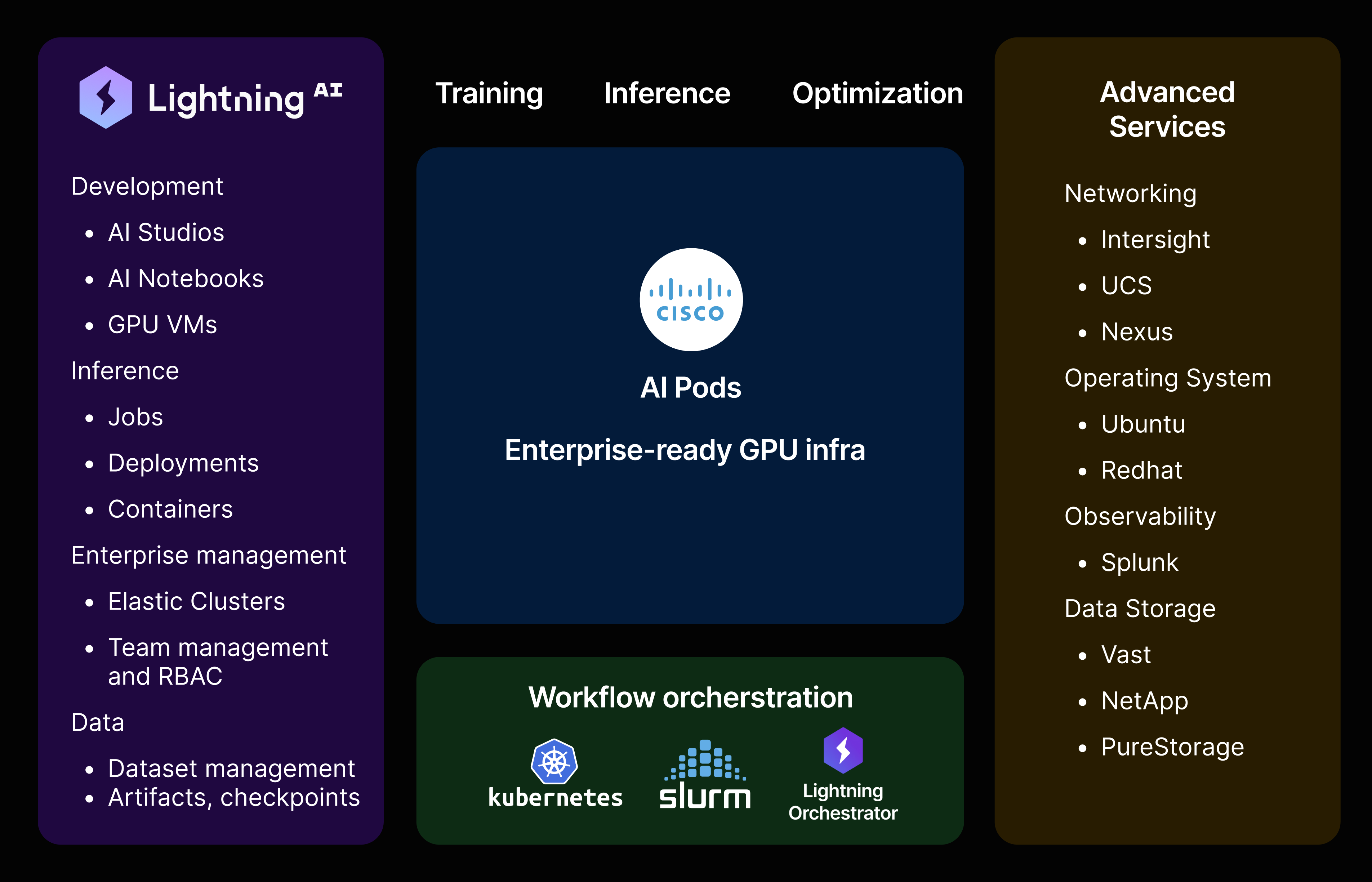
Cisco AI Pods: infrastructure for end-to-end AI
Cisco AI Pods are pre‑validated AI infrastructure stacks that combine GPU‑dense compute, high‑speed networking, storage, and enterprise‑grade software into a single, repeatable architecture.
They are designed to support the complete AI workflow. Teams use AI Pods to ingest and prepare data, train and fine‑tune models, evaluate and iterate on results, and deploy models for inference at scale. By standardizing these building blocks, Cisco AI Pods reduce infrastructure complexity, shorten deployment timelines, and make it easier to run AI workloads in private and regulated environments.
Lightning as the AI software layer
Lightning is a unified AI platform that helps teams move from experimentation to production without assembling separate systems for each step of the lifecycle.
Lightning provides a developer-friendly platform for both training and inference, along with built‑in scheduling and orchestration for GPU workloads. It also includes integrated support for experiment tracking, evaluation, and deployment, allowing teams to manage the full lifecycle of a model in one system.
On Cisco AI Pods, Lightning turns raw GPU infrastructure into a usable AI platform. It handles the operational details of running workloads while giving teams direct control over their models, data, and execution environment.
Core to Lightning is Lightning Studios, which teams use to define and run AI workloads end to end.
Lightning’s AI Studios: designed for both non-technical and technical users
Researchers, developers, and business teams can launch AI applications in minutes using low-code templates, without worrying about provisioning clusters or configuring infrastructure.
Meanwhile, engineers retain full control over experiments, multi-node training, and hyperparameter optimization, while Lightning handles orchestration, resource scheduling, and environment management.
For production and inference, Lightning turns trained models into secure, isolated AI services on Cisco AI Pods. Teams can scale inference automatically, without building Kubernetes pipelines or custom serving logic, and deploy new models quickly as they are released. This approach shortens time-to-value for enterprise AI applications and ensures deployments remain reliable, governed, and secure.
Studios allow teams to standardize how they train and serve models, reproduce results reliably across teams and environments, and promote models from development to production without re‑architecting their system. Studios can also be shared internally or across organizations, making it easier to collaborate while maintaining consistent execution and governance.
For organizations managing multiple teams, models, and compliance requirements, Studios act as a development platform with simple onboarding that scales with the business while keeping infrastructure concerns contained.
Full lifecycle, hybrid by design
Many organizations operate under constraints that limit where and how AI workloads can run. These include data residency and sovereignty requirements, security and compliance controls, air‑gapped or restricted networks, and the need for predictable performance and cost.
Lightning runs consistently across on-premises, hybrid, and cloud environments. Teams can burst AI workloads to Lightning’s fleet of 36,000 GPUs, leverage a multi-cloud marketplace spanning 10+ providers, or connect existing AWS and GCP capacity. The same workflows, tools, and visibility apply whether models run on Cisco AI Pods locally or across hybrid cloud, simplifying operational management while enabling flexible deployment strategies.
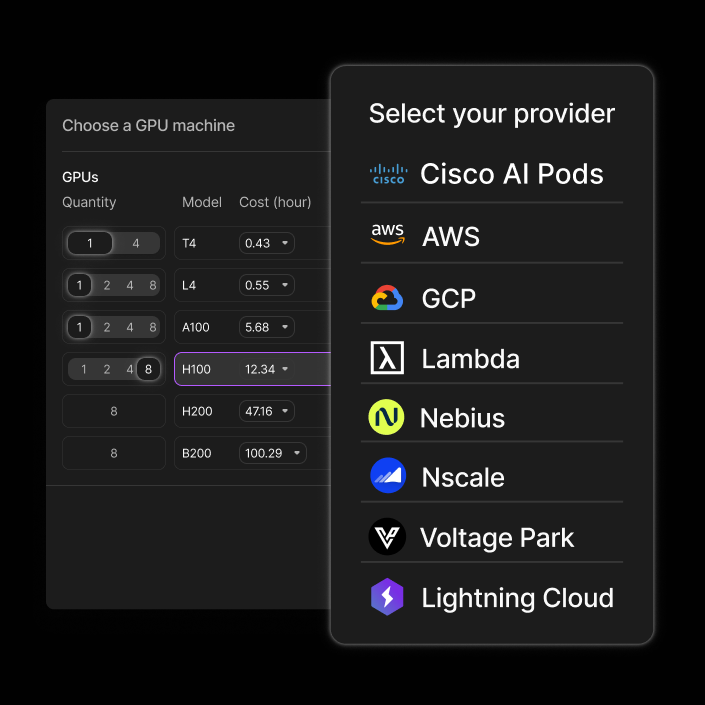
Enterprise visibility and control
Lightning provides real-time visibility into GPU utilization, training metrics, and system performance. Studios encapsulate code, dependencies, and runtime requirements, giving teams reproducible, portable environments for training, evaluation, and inference. This reduces friction between research and production, enables cross-team collaboration, and maintains security and compliance for on-prem AI workloads.
See Lightning on Cisco AI Pods at Cisco Live EU
If you are attending, visit the Lightning booth (booth VS14) to see how to run training and inference on a Cisco AI Pod with Lightning, and to talk with the team about deploying Lightning in on‑prem, hybrid, or regulated environments.
If you are not attending Cisco Live EU, you can get in touch with the Lightning team to learn more about running Lightning on Cisco AI Pods and discuss your deployment requirements.
Read more blogs and case studies
• Working with the Lightning CLI to manage Lightning Studios
• Running OpenClaw safely - Mac Mini vs. Cloud Laptop.
• View all